AI Calling vs Telecallers: Which Should You Use?
AI calling, telecallers or IVR? What each does well, what they really cost, how to hand AI calls to your team, and how to run a fair two-week trial.
By the Marro team9 min read
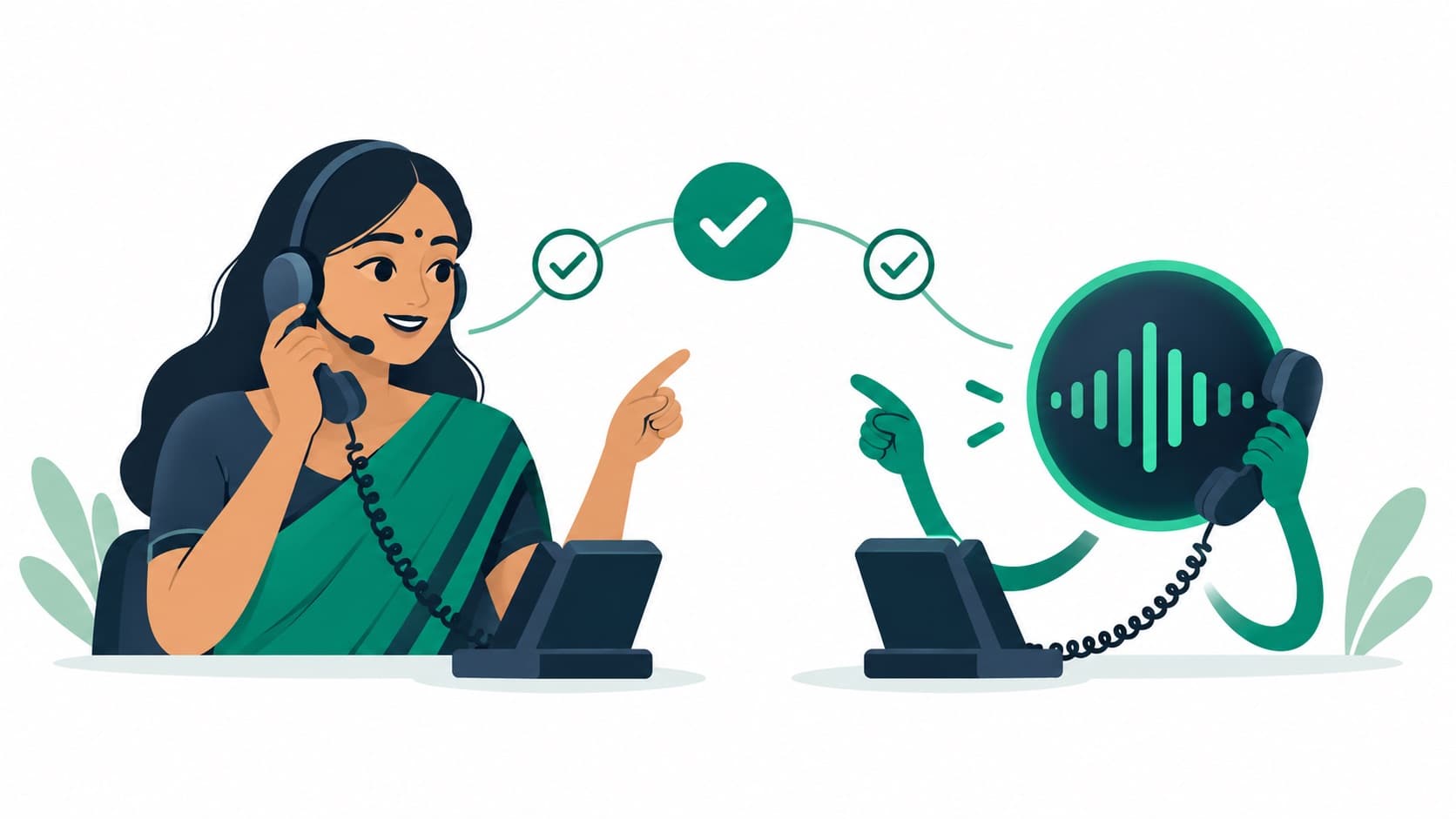
Use AI calling for the first, repeatable call: reaching every new lead within minutes, in their language, asking the same few questions and writing up the answers. Keep telecallers for the calls that close business: objections, negotiation, sensitive topics and second conversations. IVR only routes inbound callers through a menu. Most Indian sales teams do best combining them.
What's the difference between AI calling and a telecaller?
An AI calling agent holds a real spoken conversation for one defined job, such as checking interest and booking a callback, and writes down what the lead said. A telecaller does the same first call with human judgement, and can also persuade, negotiate and handle a conversation that goes somewhere unexpected.
Picture a Pune admissions consultancy in May, getting 60 enquiries a day from Instagram ads with three telecallers on the team. By 11 am, each telecaller has 15 new leads waiting and yesterday's callbacks still to do. The leads that came in at 10 pm last night get called around lunchtime, by which point many have already spoken to two other consultancies.
AI calling earns its place in the gap between when a lead enquires and when someone talks to them. The telecallers stay; they stop spending their mornings on first calls that mostly end in call me later and spend them on the leads who said yes, I want to talk to a counsellor.
How is an AI voice agent different from IVR?
IVR is a menu: press 1 for admissions, press 2 for fees. It routes inbound callers and plays fixed messages, but it can't understand an answer it didn't expect. An AI voice agent listens to what the person actually says and replies in natural speech, so it can ask questions and follow up on the answers.
IVR is still the right tool for simple inbound routing, like sending callers to the right branch or playing your clinic's hours. It's cheap, predictable and never says anything you didn't record. It can't call a new lead, ask which course they're considering, and note that they want a call after 6 pm.
| Job | IVR | AI voice agent | Telecaller |
|---|---|---|---|
| Route an inbound caller | Good: fixed menu | Possible, but more than you need | Wasted human time |
| Call every new lead within minutes | Can't | Good | Only when free |
| Ask the same five qualifying questions | Only as keypad choices | Good, in the lead's language | Good, but varies by person and mood |
| Handle objections and negotiate | Can't | Shouldn't | Good |
| Sensitive or emotional conversations | Can't | Should hand over | Good |
| Write up every call the same way | No | Automatic | Depends on discipline |
What can an AI calling agent do well?
An AI agent is best at the high-volume, repeatable first call: a clear purpose, a short script of questions and an obvious next step. It never gets tired at 5 pm, never skips the fourth question, and writes up every call the same way.
That suits a few specific jobs. A real-estate team can confirm budget, location and whether the buyer wants a site visit this weekend. An education consultancy can ask which intake and country a student is considering. And any business sitting on 2,000 old leads can find out which of them still care, without pulling a telecaller off fresh enquiries for a month.
- Calling new leads within minutes, while the enquiry is fresh.
- Speaking the lead's language, such as Hindi, Tamil or English.
- Asking the same qualifying questions on every call.
- Booking a callback time or a counsellor conversation.
- Re-checking interest across an old lead list.
- Writing every call up on the lead, with the next step.
Where do human telecallers still win?
People win wherever the call needs judgement, trust or authority: handling a price objection, negotiating, calming a worried parent, or deciding on the spot that this lead needs the senior counsellor today. Those are the calls that close business.
A Gurugram broker with three site visits on Saturday doesn't want an AI arguing over a ₹1.2 crore flat's price or talking a family through a home loan. An AI first call can confirm the visit time and what the buyer wants to see; the broker handles everything after that.
People also catch what a script misses: the hesitation that means the father, not the student, is deciding, or the casual mention that they've already paid a deposit elsewhere. A good telecaller turns that into the next move. An AI agent will write it down, and your team should read it.
How much does AI calling cost compared with a telecaller?
Compare cost per useful conversation, not cost per dial. A telecaller is a fixed monthly cost whatever the volume; AI calling is billed per minute of use, so it costs more in a busy month and little in a quiet one.
Here's a worked example with made-up numbers. A telecaller in a tier-2 city costs, say, ₹20,000 a month with phone and data, makes 120 dials a day and has around 40 real conversations, about 900 a month over 22 working days. That's roughly ₹22 per conversation before you count training, attrition and the manager's time. For AI calling, take your provider's per-minute rate, multiply by the average call length (first calls usually run two to four minutes), and add the time your team spends reading write-ups.
In Marro, AI calling minutes are billed by use from a prepaid wallet, on top of the plan; they're never unlimited, and the pricing page explains how billing works. Whichever way your numbers come out, the bigger saving is usually the leads you stop losing to a slow first call.
How should AI calls hand over to your team?
Decide the handoff before the first call: which answers send a lead to a person, who that person is, and how fast they call back. An AI write-up that nobody reads is an expensive missed follow-up.
In Marro, the handoff runs through the lead record. The call is recorded and transcribed, and the call reviewer writes up how it ended and what the lead asked, quoted in their own words, then logs the outcome and a follow-up. The follow-up coordinator plans the next step for the owner, and every action shows on the lead, so your team can step in whenever they want.
- Hand over at once when the lead asks for a person, or asks something outside your own facts.
- Give every handed-over lead a named owner and a callback time, such as within 2 hours.
- The owner reads the write-up before calling, so the lead never repeats themselves.
- Spot-check write-ups against recordings each week, especially for high-value leads.
- Review every lead the AI called that has no follow-up set.
What are the rules for AI calls in India?
AI calls follow the same rules as human ones. Under TRAI's rules on commercial communication, promotional calls go through registered telemarketing channels on the DLT system, and numbers on the National Customer Preference Register (DND) mustn't get promotional calls they haven't consented to.
Calling someone back about an enquiry they just made is a different situation from cold-calling a bought list, and consent is what separates them. Under the Digital Personal Data Protection Act, 2023, you need a person's consent to use their data and must stop when they withdraw it. So call people who asked to hear from you, say who you are and why you're calling at the start, call at reasonable hours, and record when someone asks not to be called again.
Marro builds this into how calls start. Someone on your team checks the number and permission to call, then starts the call from the lead or asks the assistant to, and only staff whose role allows AI calls can start one. The agent answers only from your business knowledge and offers a callback from a person when it's unsure.
How do you run a fair trial of AI calling?
Run a two-week split: half your new leads get an AI first call, half get your usual telecaller first call, and you compare what happens next. Pick one narrow job and one source so the two halves are comparable.
Measure outcomes, not activity: how fast leads were reached, how many had a real conversation, how many were handed over correctly, and how many reached the next real step, such as a counselling session or a site visit. Our guide to AI calling for lead qualification covers the questions to ask, and lead follow-up covers what happens after.
- 1Pick one job, such as first calls to new Instagram leads, and one goal, such as booked counsellor calls.
- 2Write the facts the agent may use, and list the questions it must hand over.
- 3Name the person who takes every handoff, and agree a callback time.
- 4Split new leads evenly for two weeks: AI first call against telecaller first call.
- 5Every few days, listen to ten AI calls and read their write-ups with the team.
- 6Compare time to first call, conversations, correct handoffs and booked next steps.
- 7Keep it, widen it to a second job, or stop, based on those numbers.
Which should your business choose?
Choose by volume and by how much judgement the first call needs. If you get more new leads a day than your team can call within the hour, add AI first calls. If most of your calls are second and third conversations about money or decisions, hire good telecallers first.
Common mistakes: pointing an AI agent at every old lead on day one, skipping the handoff rules, judging it on calls made instead of next steps booked, and letting telecallers stop reading write-ups. Start narrow and widen only when the handoff works. For how AI calling fits into a CRM that also plans each lead's next step, see what an agentic CRM is and how Marro's AI calling works.
| Your situation | Start with | Why |
|---|---|---|
| Under 15 new leads a day, one or two callers | Telecallers | They can reach everyone quickly; AI adds little yet |
| 40 or more new leads a day, mostly from ads | AI first calls, telecallers on handoffs | Speed to first call decides who gets the lead |
| Thousands of old, uncontacted leads | AI calls to re-check interest | Frees telecallers for fresh enquiries |
| High-value, negotiated sales | Telecallers, AI only to confirm visits or times | The conversation is the sale |
| Mostly inbound calls asking for a department | IVR | Cheap, simple routing is enough |